Built for the Road: How Chefs Design an Off-Site Menu That Arrives Intact
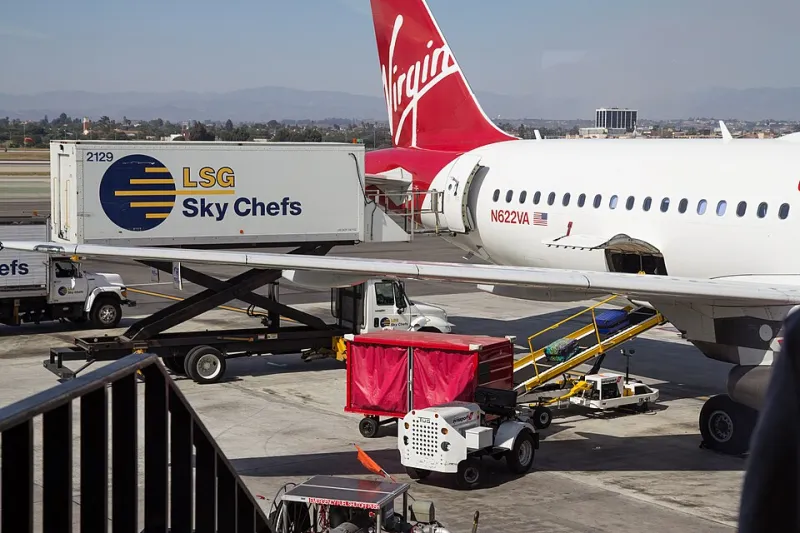
Photo: Atomic Taco from Seattle, WA, USA, CC BY-SA 2.0, via Wikimedia Commons
An off-site dinner does not begin when the first guest sits down. It begins hours earlier, in a kitchen that may be twenty minutes or two hours from the table, and everything in between is a negotiation with physics. Heat dissipates. Emulsions break. Fried food steams itself soft inside a closed container. Chefs who cater away from a venue kitchen do not simply cook a menu and drive it somewhere; they design a menu for the drive.
The Plate Is Not the Product
In a restaurant, the distance between stove and diner is measured in seconds. Off-site, it is measured in minutes and, on a difficult evening, in hours. That shift changes how a chef evaluates a dish. Flavor remains important, but it is no longer the only test. Every candidate dish is judged on a second question: how does it behave when no one is watching it?
A chef building a travel menu asks three things of each course. What will this look like after forty minutes in a holding cabinet? What happens to the texture when it cools by two degrees? And can it be finished with one burner and one pair of hands in a room that was never designed as a kitchen?
Selecting by Failure Mode
The most useful exercise in off-site menu writing is to imagine how each dish fails. Braises, tagines, and long-simmered stews travel beautifully because they improve with a little patience. Gratins hold their heat and their structure. Grain pilafs, farro salads, and roasted vegetable compositions forgive a delay. Cured and marinated items, dressed at the last moment, arrive with their character intact.
Other dishes are quietly disqualified. Tempura and anything else built on a fragile crust lose their reason for existing inside a closed container. Delicate greens dressed in advance wilt into a single texture. Risotto stiffens into something closer to a cake. A soufflé is a wonderful idea in a dining room and an impossible one in a van.
This is not a compromise of ambition. It is a redirection of it. A chef who understands travel will spend the creative energy on sauces, contrasts, and finishing touches that survive the journey rather than on techniques that require a kitchen thirty feet away.
The Temperature Problem
Food safety sets one threshold and quality sets another, and the two are not the same. Holding cabinets keep hot food above the temperature required by health code, but the window in which a dish still tastes like itself is considerably narrower. A chicken breast cooked to the legal minimum and held for an hour will be safe and dry. A chef solves this by cooking to a lower internal temperature, chilling quickly, and completing the cook on site in a water bath, a combi oven, or a pan.
Cold service runs on the same logic in reverse. Raw fish, chilled soups, and dairy-based desserts need their own coolers, their own ice pans, and, often, plates that have been refrigerated before service. Cross-contact between hot and cold holding is one of the most common failures in remote catering, and it is almost always an equipment decision made days in advance rather than a mistake made on the night.
Equipment That Buys Time
A well-planned remote service looks less like a restaurant and more like a small expedition. Holding cabinets, insulated transport containers, induction ranges, and folding work tables are the basics. On-site finishing equipment depends on the venue: a plancha or portable grill for proteins, a circulator for reheating, butane burners for sauces that must be brought back to temperature at the last possible moment.
Experienced chefs build an equipment list at the same time they write the menu, not afterward. If the venue has no venting, the menu should not depend on high-heat searing indoors. If the service area is two flights of stairs from the loading dock, the number of trips becomes a design constraint, and light, stackable containers matter more than elegant ones.
Finish the Last Ninety Seconds on Site
One principle organizes most successful remote service: the final ninety seconds belong to the venue, not the kitchen. Sauces travel in squeeze bottles and are applied at the pass. Herbs are cut on site. Acids, citrus, and finishing salts are added after plating. Garnishes are assembled rather than transported. Carving happens in the room, where the aroma is part of the experience.
This division of labor is what allows a menu to feel composed rather than reheated. The guest sees a plate being completed, not a plate being uncovered.
The Timeline Is the Recipe
A catering timeline is written backward from the first course. Load-out, travel buffer, unloading, setup, and a margin for the unexpected are all fixed before service begins. Chefs plan for the four-hour window in which food may sit without temperature control, and they plan for the far shorter window in which it is still worth serving.
Weather, traffic, and building access are variables that belong in the plan rather than in the apology. A caterer who asks about elevator dimensions and loading dock hours is not being fussy. That conversation is where a smooth evening is actually built.
What Event Planners Should Ask
Before booking catering outside a traditional venue kitchen, ask how each course is held, what equipment the caterer brings, where the on-site finishing will happen, and who is responsible for power and water. Ask what happens if the truck arrives late. A confident answer, given in specifics rather than reassurances, is the clearest sign that the menu was engineered for the road rather than merely cooked for it.